Obsidian
Every geek sooner or later gets the desire to make their Personal Knowledge System. Like a wiki, only about yourself. A dump of your brain, if you will.
For me, for almost a decade now, I've had something like Daily Notes in some form, into which I unloaded all my RAM and wrote down various finds and solutions. Before they were just txt files, then markdown in the same Sublime Text. The appearance of Notion and the transition to it in '19 was to some extent pivotal for me, I realized that my notes can somehow be linked to each other, create some notes inside others. But after some time I got so tired of how Notion lags and doesn't work without internet that I almost stopped going there.
The main discovery of the year for me, if we're talking about software and how it can change life - Obsidian. I haven't experienced such pleasure from software in a long time. Here everything just works as it should and is customizable to anything. At its core, it's just a local markdown file editor. But smart - with links, tags, with plugins. Due to locality it feels incredibly fast, despite being written in Electron. The fact that it's written in Electron so far only plays in plus, because the developers release new features with some incredible speed.
In such software, the most important thing is to start working somehow, over time you'll understand what's more convenient for you to live, otherwise there's a big risk of going to read about how complex and different work is organized by other people, break down somewhere on the word Zettelkasten and give up. All this isn't needed. It's just important to understand that this is a very flexible tool for working with knowledge. It will adapt to you over time, not you learning something.
In addition to daily notes, which are a pleasure to keep with templates and calendars, I write many summaries. Read some technical post - wrote down key points in a note, left links. If in conversation with someone a thought pops up that I saw something like that in a talk, quickly found it in my notes and sent a link. Watched a talk - wrote it down, sprinkled with links for the future to see connections. Meeting - pressed a couple of hotkeys, a note was created according to a given template, wrote down the agenda, discussion results. Great. Solved a problem on LeetCode - wrote down my thought process according to a template. Links - awesome autocomplete mechanism. Consider that Obsidian is my IDE for text. Wrote a person in the list of meeting participants once, next time their name will autocomplete, you can find all meetings with them in a couple of clicks. And it's due to all this convenience - sooner or later a system appears. With a mechanical keyboard it's just a pleasure to write out these notes.
The main minus (which is also a plus) - you have to store and backup files yourself somewhere (but privacy), and these are just text md files. However, some Google Drive solves this problem perfectly. If you want - even store in a repository on GitHub. Well, and with mobile the experience isn't the best, first files need to be somehow delivered to mobile, second it's just not very convenient, like writing code from a phone, I swear. On the phone I write micro-notes in something like Keep or Telegram saved messages, write them down in Obsidian when I get to a keyboard. The second minus is that it really changed life so much that I can't just take and read something, in my head sits the thought that I should write this down. Maybe this is good, saves time.
You need to understand that this is really big work, requiring time. One thing is to read some post diagonally, another thing is to write down conclusions and format into a summary. The first is easier, of course, but in the second case you have an artifact left, not to mention that by writing things in our own words we remember this better. In general, for Obsidian the expression "easy to learn, hard to master" fits perfectly. The further you go, the cooler use cases you can come up with.
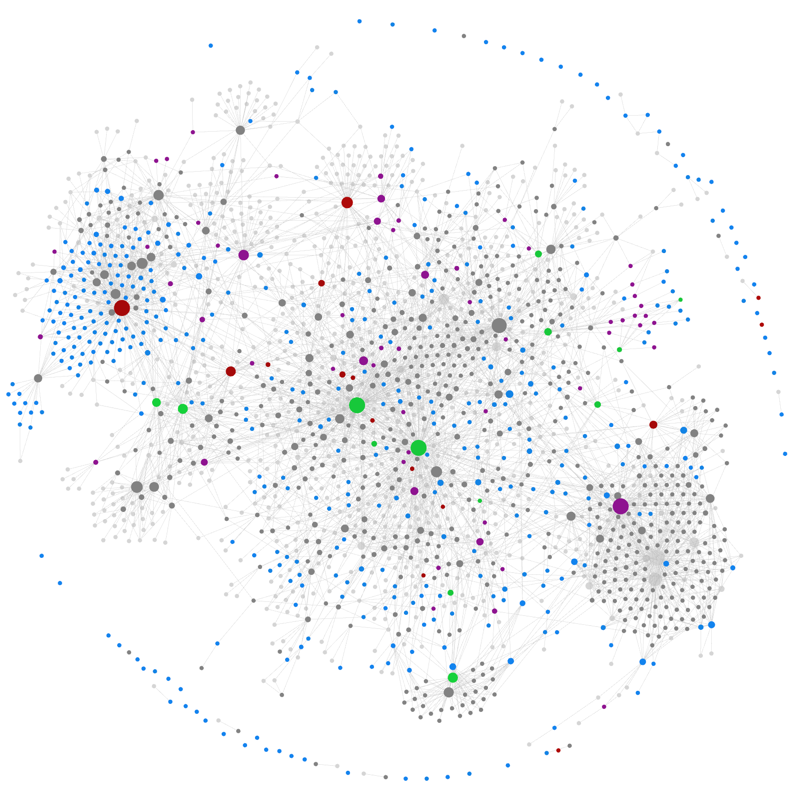
The most useless feature - the graph of connections in the vault that you see in the image. But, damn it, beautiful. I'm ending the year having on the counter as many as 1012 notes, and these are only created ones, there are many times more links without notes.
Highly recommend